
Deep Listening in Ardakh Nurgaz’s Korkut–Rumi–Spinoza Model of Modern Poetics
Within Ardakh Nurgaz’s modern poetics, Deep Listening can be understood as a key methodological principle underlying the intertextual relationship among Korkut, Rumi, and Spinoza. Rather than referring simply to the act of hearing or listening, Deep Listening describes a poetic mode through which different historical, cultural, and intellectual voices are received, allowed to resonate, and transformed within the consciousness of the contemporary poet.
In this sense, Korkut, Rumi, and Spinoza should not be treated merely as three cultural figures placed side by side. They constitute three different modes of approaching existence, while Deep Listening functions as the relational process through which these modes become poetically resonant.
The movement may therefore be summarized as:
Listening → Resonance → Transformation
The poet does not simply read Korkut, Rumi, or Spinoza and reproduce their ideas. Rather, he enters into an imaginative relationship with their voices, temporarily suspends their historical distance, and allows their different forms of existential experience to speak again within the present.
1. Korkut: Listening to the Voice of Mortality
Korkut represents the first level of Deep Listening: listening to death.
The significance of Korkut in Nurgaz’s poetics lies not merely in his status as a figure of Turkic cultural memory, but in the existential experience associated with him—the confrontation between the human subject and mortality.
The fundamental question is:
How can the human being respond to death?
Korkut therefore becomes a poetic figure through whom the subject encounters the limit of its own existence.
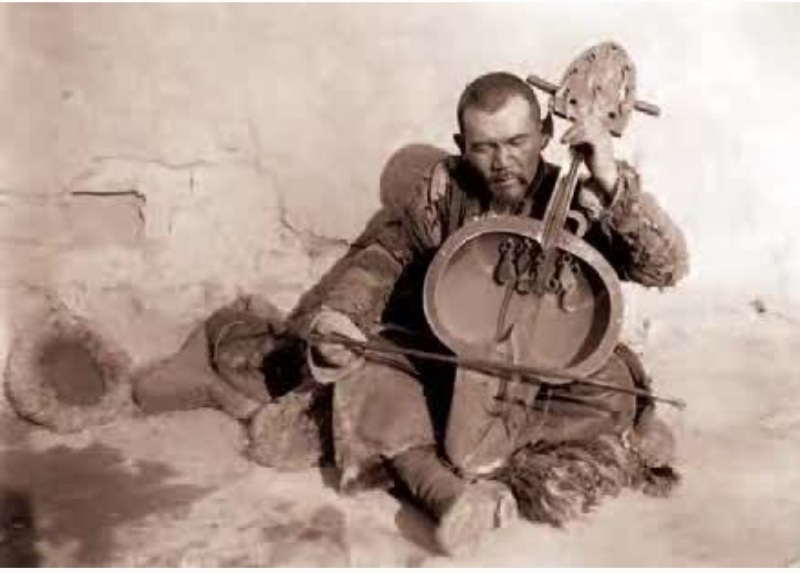
The qobyz, traditionally associated with Korkut, is particularly important in this context. It can be understood not simply as an ethnic or folkloric symbol, but as a medium through which mortality is transformed into sound. The body may disappear, but sound can continue to resonate.
Thus, the poetic movement becomes:
Death → Sound → Music → Poetry
Deep Listening at this stage means listening to the voice of a cultural figure whose historical existence has already passed, yet whose sound continues to inhabit cultural memory.
Korkut therefore represents:
the voice of mortality.
The poet does not merely learn about Korkut; he listens to the existential question carried by Korkut.
2. Rumi: Listening Beyond the Self
With Rumi, Deep Listening moves from mortality toward the structure of the self.
Korkut raises the question:
“I will die.”
Rumi makes the question more radical:
“Who is this ‘I’ that fears death?”
This shift is crucial. Rumi does not simply introduce religious or mystical content into Nurgaz’s poetry. Rather, he transforms the position of the poetic subject.
Korkut confronts:
I ↔ Death
Rumi opens:
I → Self-transcendence → Greater Existence
The subject is no longer understood as a closed and autonomous entity. Through love, spiritual transformation, rhythm, poetry, and the dissolution of rigid ego boundaries, the self becomes capable of listening beyond itself.
Thus, if Korkut represents:
listening to mortality,
Rumi represents:
listening beyond the self.
This is why music and rhythm are important to the Rumi dimension of the model. Listening here is not merely intellectual reception. It is an experiential opening in which the boundaries of the self become less rigid.
Rumi therefore represents:
the voice of the soul.
3. Spinoza: Listening to Nature and Existence
The third stage is represented by Spinoza.
Here Deep Listening undergoes another transformation. The object of listening is no longer merely another human or spiritual voice. It becomes nature itself.
Spinoza introduces a philosophical vocabulary through which the rigid separation between the human subject and the larger order of existence can be reconsidered.
This is especially significant in Nurgaz’s poetic treatment of Spinoza. If the poem moves from the Netherlands, Dutch painting, and tulips toward the Kazakh steppe, then philosophy is not simply being imported from Europe into Central Asian poetry. It is being transformed through image, landscape, memory, and sensory experience.
The movement can be represented as:
Spinoza → Netherlands → Painting → Tulips → Steppe → Nature
Here philosophical abstraction becomes sensory experience.
The poet does not simply explain Spinoza’s philosophy. Instead, philosophical thought is transformed into colors, flowers, landscape, seasonal change, memory, and sound.
In this sense, Spinoza represents:
listening to nature.
The movement of transcendence therefore changes direction. It no longer means escaping the world. Instead, transcendence becomes an intensified awareness of one's belonging to the larger order of existence.
Spinoza thus represents:
the voice of nature.
4. From Three Voices to One Resonance
The three figures can therefore be understood through three modes of listening:
Korkut — listening to death
Rumi — listening beyond the self
Spinoza — listening to nature
These should not be understood as identical philosophical doctrines. Their historical and intellectual differences remain essential.
What connects them is not that they literally express the same worldview, but that Nurgaz’s poetry can place them within a shared field of existential questioning.
The movement is therefore:
Mortality → Self-transcendence → Immanence
or:
Death → Soul → Nature/Existence
The ultimate point is not to erase the differences among Turkic mythology, Sufi poetry, and European philosophy. Rather, it is to create a poetic condition in which their differences can become resonance.
This is where Deep Listening becomes fundamental.
Deep Listening does not erase cultural difference; it creates a poetic condition in which difference can become resonance.
5. Deep Listening and the Suspension of Historical Time
Deep Listening is closely connected with Nurgaz’s use of poetic time.
Korkut, Rumi, and Spinoza belong to radically different historical periods. Within linear historical time, they cannot enter into a literal dialogue.
Poetry, however, can create a different temporal structure: a poetic present in which multiple historical moments become simultaneously accessible.
Thus:
Korkut’s ancient voice
Rumi’s medieval voice
Spinoza’s early-modern philosophical voice
Nurgaz’s contemporary poetic voice
can coexist within one poetic space.
Temporal suspension therefore creates the condition for Deep Listening.
Conversely, Deep Listening gives this suspension of historical time its poetic purpose.
The poet does not abolish history. Rather, he allows different historical times to become simultaneously audible within the present.
This can be described as:
historical simultaneity produced through poetic listening.
6. From Citation to Resonance
This distinction is essential for understanding Nurgaz’s intertextuality.
A conventional form of intertextuality might operate through:
quotation → reference → allusion
Deep Listening operates differently:
voice → listening → resonance → transformation
Nurgaz does not simply place Korkut, Rumi, and Spinoza into the same poem as representatives of three civilizations.
Instead, their voices are allowed to encounter one another within the poetic consciousness.
The result is therefore not cultural collage but poetic resonance.
The question is not:
“How can these three traditions be combined?”
but rather:
“What becomes audible when these different traditions are allowed to listen to one another?”
This distinction is central to Nurgaz’s cross-civilizational poetics.
7. The Poet as a Listening Subject
Deep Listening also changes the position of the poet.
In a conventional model of poetic subjectivity, the poet is primarily a:
speaker
The poet produces and projects a voice toward the world.
In Nurgaz’s Deep Listening model, however, the poet can be understood first as a:
listener
The poetic subject becomes receptive rather than purely expressive.
The poet listens to:
Korkut → Rumi → Spinoza → landscape → memory → nature → the contemporary world.
The poet's task is therefore not simply to invent a new voice, but to discover and transform voices that already exist within cultural memory, history, nature, and human experience.
This produces what may be called a listening subject.
The subject becomes a site of convergence rather than an isolated center.
8. Music as the Medium of Deep Listening
Music provides perhaps the most direct medium through which Deep Listening operates.
Korkut is associated with the qobyz and the persistence of sound.
Rumi’s poetic and mystical tradition is deeply connected with rhythm, song, movement, and spiritual resonance.
In Nurgaz’s treatment of Spinoza, musical memory and the relationship between poetry and music further extend this sonic dimension.
Music is therefore more than a thematic element.
Music does not merely represent listening; it performs listening.
Unlike conceptual language, music does not require a fixed conceptual boundary in order to generate meaning. It operates through rhythm, repetition, resonance, duration, and affect.
This makes music an ideal medium through which different historical and cultural voices can enter into relation.
The structure can therefore be represented as:
Korkut → qobyz → sound
Rumi → song/rhythm → spiritual resonance
Spinoza → melody/world → natural resonance
and ultimately:
Music → Deep Listening → Resonance → Voice of the World
9. From the Speaking Subject to the Listening Subject
At its deepest level, Deep Listening involves a reversal of the relationship between the human subject and the world.
A conventional modern subject might be represented as:
I → World
The subject speaks, observes, interprets, and treats the world as an object.
Deep Listening reverses this direction:
World → I
The world becomes something that speaks, while the poet becomes the listener.
Eventually, the distinction becomes even less rigid:
I ∈ World
The subject is no longer positioned outside the world as an autonomous observer. It becomes part of a larger network of existence and resonance.
This is where the Spinoza dimension of the model becomes particularly significant: transcendence no longer means leaving the world behind, but recognizing one's immanent relation to it.
10. Toward the “Voice of the World”
The “Voice of the World” should therefore not be understood as a single mystical voice or as the claim that Korkut, Rumi, and Spinoza were secretly expressing exactly the same philosophy.
A more precise interpretation is:
The “Voice of the World” is not a single voice, but a condition of resonance among multiple voices.
Korkut, Rumi, and Spinoza remain historically and intellectually distinct.
Deep Listening does not eliminate these differences.
Rather, it enables the differences to become mutually resonant within the poetic present.
Thus:
Korkut gives the poet a voice to listen to.
Rumi teaches the poet how to listen beyond the self.
Spinoza expands listening from the human voice toward nature itself.
Deep Listening is the poetic practice through which these voices become resonant as a “Voice of the World.”
In this sense, Deep Listening is not a fourth point alongside Korkut, Rumi, and Spinoza. It is the relational dimension connecting the three points.
The model may therefore be visualized as:
DEEP LISTENING
│
┌───────────────┼───────────────┐
│ │ │
KORKUT RUMI SPINOZA
│ │ │
Mortality Self Nature
│ Transcendence │
│ │ │
qobyz Song Landscape
│ │ │
└───────────────┼───────────────┘
│
RESONANCE
│
VOICE OF THE WORLD
│
EXISTENCE
The deepest implication of this model is therefore not that Nurgaz simply combines Turkic mythology, Eastern mysticism, and European philosophy. Rather, his modern poetics can be read as an attempt to create a listening space in which different civilizations, historical periods, human voices, and natural forms become simultaneously audible.
The movement is ultimately:
Korkut: listening to death
↓
Rumi: listening beyond the self
↓
Spinoza: listening to nature
↓
Deep Listening: allowing these voices to resonate
↓
The Voice of the World: existence experienced through resonance
Thus, the fundamental poetic movement is not simply Kazakhstan → East → West, but:
Death → Self → World
or, more precisely:
Finitude → Self-transcendence → Immanence
Within this framework, Nurgaz’s intertextuality becomes more than a juxtaposition of cultural references. It becomes an ethics and aesthetics of listening: a poetic practice through which historical difference is preserved while new forms of resonance become possible.