
Ardakh Nurgaz. Women in the Epic “Kabanbay Batyr”
Written literature is directly interconnected to oral literature. The bridge that links them consists of legends, folktales, and myths. Due to the conventions of writing, written literature transforms these elements—legends, folktales, and myths—when they are recorded, absorbing and reinterpreting them according to new demands. Behind this transformation lie shifts in worldview and aesthetic perception. Although literary taste evolves and reading replaces listening as the primary mode of engagement, many elements are preserved. For instance, from the internal structure of Kazakh epics, we can gain insight into the spiritual world of their anonymous creators. Despite being intended for oral performance, these epic texts retain enduring literary features that continue to resonate with modern intellectual literature.
In Kazakh history, one of the central figures of the historical event known as the “War against the Dzungars” in the 17th century is Kabanbay Batyr. Among the narrative poems dedicated to him, the version most widely circulated among the people is based on an episode from his old age, when he sets out on a campaign. Researchers note that there are 17 variants of this version. The legend underlying the poem is as follows: a Kyrgyz tribe that had settled in the Alatau region and assimilated into the Dzungars attacked the village of Kabanbay Batyr’s close younger brother, named Arys, and massacred all the men. When the aged batyr arrives at the devastated, blood-soaked village, he is struck with grief. At that moment, he hears the cry of a child from beneath an overturned cauldron. Lifting it, he finds an infant boy underneath. Moved to tears, he says, “So at least one descendant of Arys has survived.” The epic “Kabanbay Batyr” continues from this point. Kabanbay Batyr gathers troops and sets out on a campaign to avenge the Kyrgyz-Dzungar tribe's attack on Arys’s village. According to the epic, nearly all the batyrs known in the history of the war against the Dzungars, including Ablai Khan, take part in this campaign. During the expedition, the warriors led by Kabanbay encounter a migrating Kyrgyz-Dzungar settlement. In the final stage of the battle, Kabanbay Batyr kills the enemy hero known as Aiteke Zhyryk in single combat.
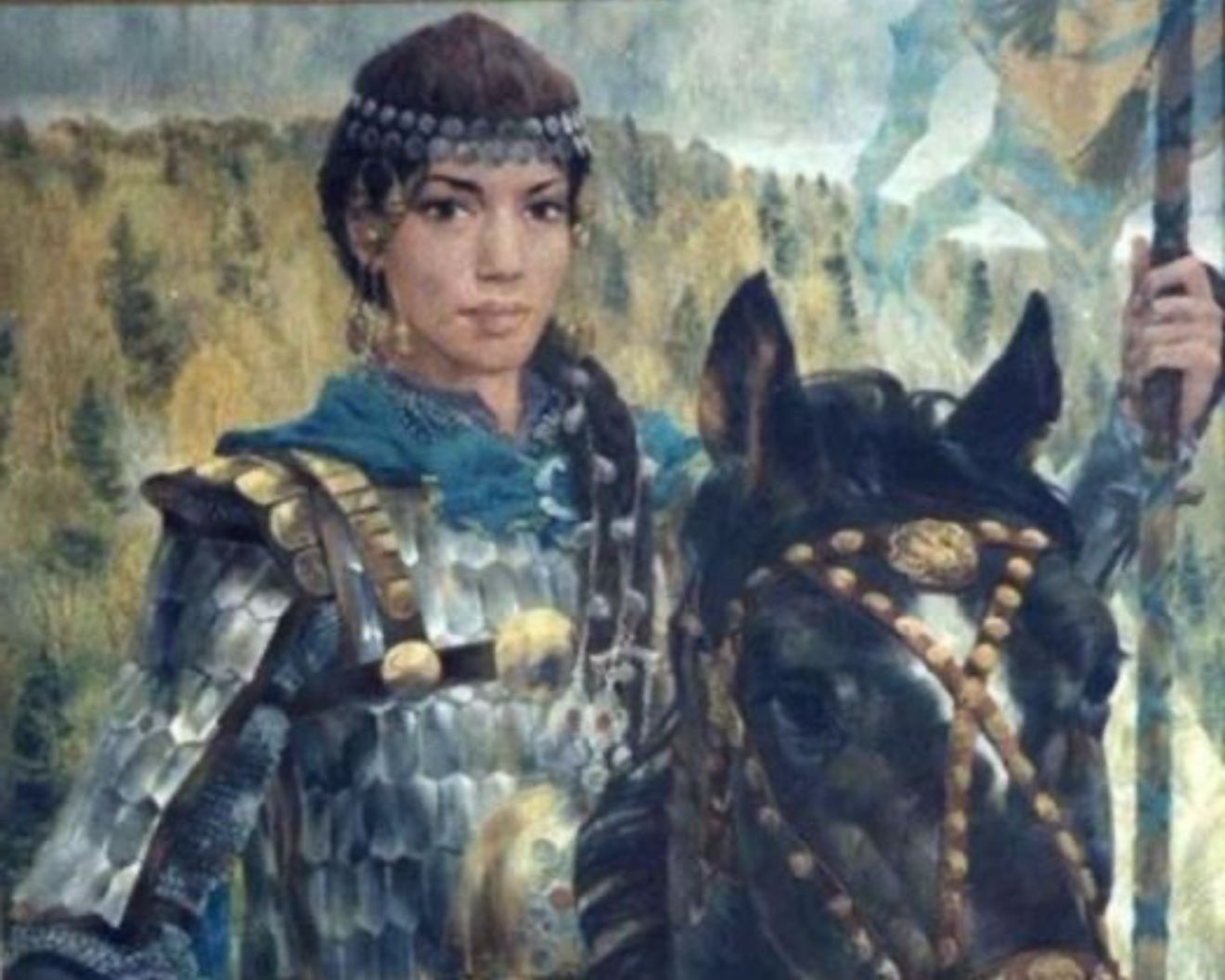
At this point, the epic truly begins to unfold. Alongside Kabanbay Batyr, other named warriors appear in the narrative, and particular attention is given to historical figures such as Dauletbay and Shagalak. However, they are not the ones who sustain the work's spiritual atmosphere. Instead, it is shaped by Kabanbay Batyr and two female figures. The narrative is constructed around the dynamic formed by this triad. The first female character enters the scene as follows: upon witnessing the death of Aiteke Zhyryk, a girl from the Kyrgyz-Dzungar side arrives, leading a white-headed camel calf. She asks for the body of her father, who was killed in single combat. However, she is portrayed differently from female characters in other Kazakh epics. The text describes her as follows:
Skirting along the Alatau, the Kyrgyz arrived—
Not by night, but in broad daylight, they came.
Seeing that her father had been slain,
A girl approached, leading a white-headed camel calf.
In Kazakh history, scholars widely acknowledge that women often paid a heavy price during times of warfare. As a result of invasions, many of our women were captured by enemy forces, subjugated, and assimilated into foreign communities. Numerous details reflecting this reality can be found in Kazakh narrative poems (qissa-dastans). One recurring motif is that of a Kazakh woman who, having been taken captive and having become the mother within another community, advises her daughter: “My child, you carry Kazakh blood—marry a Kazakh.” This motif has left such a deep imprint on cultural memory that it appears in both the 20th-century poet Isa Baizakov’s poem “Quralai Sulu” and the film Nomad. However, the anonymous author of the epic “Kabanbay Batyr” departs from this traditional pattern. Instead, a completely different female image is presented. This shift is intentional and stems from a distinct creative vision. The girl who comes to ask for her father’s body speaks boldly to the warriors: “You may destroy the people, annihilate them, and one of you may take me, but I will not remain a mere wife forever…” At this point, the epic narrates the scene as follows:
He lifts his glowing spear—Kabanbay prepares,
The girl cries out, lamenting her father in despair.
As she wails for the one who has fallen,
The warriors listen—and halt where they stand.
She comes forward, walking straight ahead,
Leading a white-headed camel calf by the thread.
Her voice rises, filled with grief:
“My father—oh, my dear father!” she cries in anguish.
“I will not sit—I will rise,
I will go before the warriors’ eyes.
I will beg them—grant me grace,
Return my father’s body to its place.
A lake may dry up and turn into shallow ground,
A man grows weary when no wealth is found.
I told you not to leave—yet you went,
In a quarrel with your kin, in anger so?
I told you not to leave—yet did you part,
Did you untie the ropes that bound your heart?
You led your people far away—
Did you reach the throne you sought that day?
Kabanbay has laid you low—
You failed to strike, to deal your blow.
Your swift gray steed—what held you back?
Why could you not return the attack?
Just moments ago you walked, my father dear—
Why was your death so sudden, so severe?
Even fleeing, Kabanbay pursued—
Did you fall without avenging a feud?
You fell beneath a warrior’s hand—
Did your strength fail to take a stand?
Kabanbay’s spear—like birch, unbent,
My father’s—like pine, too quickly spent.
Kabanbay, born among the Kazakhs bold,
Strikes straight into the heart, I’m told.
Oh my father, my pride, my flame—
You lie like a lion, yet death has come.
…
If I ride a horse, it lacks a shoe,
If I dress in silk, no collar, true.
How shall I live, how shall I stand,
With no elder brother at my hand?
If I wear boots, no lining inside,
If I wear a shirt, no coat to hide.
How shall I live, how shall I be,
With no elder sister guiding me?
My days are filled with cries of grief,
My soul finds neither rest nor relief.
How shall I live, what shall I do,
With no younger brother growing up?
A lonely girl without a brother near,
A forsaken one with none held dear.
Like a star suspended in the sky,
With countless dreams that drift and die.
A sable lost upon the plain,
A sprig of mint in waterslain.
Do not make me weep, O Kazakh, no—
I am my mother’s only child below.
May your food be sweet as honey poured,
May your camels bear a noble load.
Do not make me weep, O Kazakh, please—
Perhaps you have a child like me.
I will not sit—I will arise,
I will act, I will not compromise.
Before you, warriors strong and proud,
I will plead my case aloud.
If you grant me mercy now,
If you hear the words I vow—
Listen to my grief, my pain,
Let me speak my heart again.
What I ask of all of you—
Is but a drop of blood, so few.
My strength is not enough to fight,
God alone knows wrong from right.
One of you may take me home,
Lead me where I must now roam.
Slaughter sheep if the herds you keep,
Hold your feasts in joy complete.
But I will not remain your wife forever—
One day you will regret it, never
Finding peace where I once lay—
You will mourn and turn away.”
Although others do not understand the girl’s words, Kabanbay Batyr does. She belongs to the enemy side and is, moreover, a physically powerless woman; he pays particular attention to her speech, reflects on it, and ultimately fulfills her request. The author’s underlying intention is precisely to foreground this pivotal moment.
In literature, true originality is measured by the ability to present artistic imagination in a way that is unique and inimitable within the text. In the lines cited above, the anonymous author of the epic demonstrates an extraordinary and distinctive poetic voice characteristic of Kazakh verse. All the features of a singular artistic creation are present. The moment when the girl enters the scene coincides with the peak of dramatic tension in the narrative. This is clearly not accidental but the result of deliberate artistic design and considerable experience. It is precisely at such moments of heightened conflict that the inner depths of the human soul are most fully revealed, allowing for deeper psychological insight. The warriors have defeated their enemy; now the defeated side faces mass destruction and severe punishment. According to the laws of warfare of that time, the victors would annihilate all the men, take the women captive, and divide the livestock and property among themselves. At the very moment when this is about to begin, the girl leading a white-headed camel calf steps forward from the defeated side. Her words carry profound meaning. In these verses, one finds a powerful psychological portrayal emerging from intense, tragic conflict, one that reveals the deep and often hidden layers of the human soul. Consider this: although the girl slightly reproaches her father, who was killed in single combat, she does not pity him; instead, she elevates and honors him, valuing his death on the battlefield as something sacred. She does not curse or unjustly condemn the warrior who killed her father; rather, she acknowledges his worth and status with fairness. At the same time, she skillfully expresses her grief, personal sorrow, and inner wishes. She even speaks of the material motives that led her father to go to war. Overall, these stanzas convey an immense depth of meaning. At this critical moment, on the brink of bloodshed, the girl metaphorically lifts an enormous burden with her words, carefully, without excess, placing it precisely where it belongs. Her speech is measured but not arrogant, delicate and concise, yet firm and resolute. These lines flow with clarity and aesthetic elegance. The girl’s words are the product of exceptional wisdom. To speak at such a level under extreme circumstances is no simple task. Such comprehensive and balanced expression—encompassing all sides of the situation—requires not only depth of thought but also a listener capable of understanding it fully. That listener, of course, is Kabanbay Batyr. Through the image and character of the girl, the author simultaneously constructs and reveals the image of the batyr. Remarkably, by shaping one character, the author succeeds in illuminating two. Such mastery is rare even in world literature. It brings to mind William Shakespeare’s Macbeth, where the inner turmoil of Macbeth, driven to a tragic act of violence, is conveyed through the monologue of his wife.
The second female character in the epic is Kabanbay Batyr’s daughter-in-law—the wife of his younger brother, Dauletbay. At the end of the narrative, as Kabanbay lies on his deathbed, he repeatedly looks toward the door, as if searching for his brother Dauletbay, who had left in resentment. It is this daughter-in-law who first understands the condition of the batyr—lying weak, awaiting, and thinking of those who have departed. The author does not expend many lines here, yet conveys the idea with remarkable artistic precision. First, he shows how the batyr himself recognized and valued his daughter-in-law; then, she proves to be worthy of that evaluation through her distinct character. Even before receiving news of her father-in-law’s grave condition, she intuitively senses that “something bad has happened.” She then addresses her husband Dauletbay, expressing—almost word for word—from her own perspective what Kabanbay himself would have said. Here again, the author employs repetition in a refined and deliberate manner. Through the carefully constructed image of the wise daughter-in-law, the figure of Kabanbay Batyr is elevated and deepened. This can only be described as true artistic mastery. In other words, by revealing the rare and valuable qualities embodied in these two female characters, the author enriches the image of Kabanbay with unique depth and power. In this portrayal, Kabanbay is not merely a heroic warrior, but also a man of foresight, nobility, and profound wisdom. The poet achieves this not through overt praise or exaggerated rhetoric, but by embedding these qualities organically within the imagery and meaning. In heroic epics, which typically emphasize valor and warfare, such subtle, nuanced, and emotionally rich expressions—hidden within seemingly small details—are not often encountered. From this, we may conclude that the author of the epic was not merely a skilled wordsmith but a creative figure of exceptional aesthetic sensitivity, someone whose artistic vision surpassed that of their time. From the perspective of modern literary studies, such intricate aesthetic and psychological layering can only emerge from a rare poetic sensibility—one that reflects singular creative intuition.
We encounter a similarly remarkable artistic signature in another epic, “Koblandy Batyr”. Like the previous work, its author is unknown. I would suggest that the author may have been a woman. The reason lies in the fact that although the central hero is Koblandy Batyr, the spiritual core and structural integrity of the work are shaped by his wife, Kurtka. Formally, she appears as a secondary character; yet, in essence, she functions as the foundation of the entire narrative. While the author uses literary technique to keep Kurtka in the background, her role at each stage reveals her indispensable presence in shaping the overall meaning of the work.
Kurtka first distinguishes herself by recognizing and choosing Koblandy’s warhorse, Taiburyll. It is impossible to imagine Koblandy without Taiburyll, and behind Taiburyll, from beginning to end, stands Kurtka. Throughout the epic, Koblandy himself is often unaware of what lies ahead, whereas Kurtka fully understands future events and acts accordingly. What does this signify? It suggests that Kurtka possesses qualities akin to those of the author—she is endowed with a perspective that allows her to “organize” the entire narrative from beginning to end. One of the central concerns of 20th-century literary theory is identifying the position and presence of the author within the text. Through this, scholars uncover the worldview and aesthetic sensibility of the creator, as well as the originality of the work. From this perspective, the importance of Kurtka becomes even more apparent. For example, when passing by the herd of Koblandy’s relative, Kurtka deliberately asks for and keeps the gray mare, the mother of Taiburyll. In another episode, when Koblandy prepares to set out on a campaign in anger after hearing Karaman Batyr’s words, Kurtka gives him Taiburyll but warns him: “Taiburyll still lacks forty-three days of training. When you one day drive back Kobikty’s horses and two gray mares break away from the herd, you will realize this shortcoming when you fail to catch them.” The epic unfolds exactly as she predicts. In a third instance, as Koblandy returns from battle, riding swiftly through the night, he falls from his horse. At the place where he falls, he finds a stake—the very one Kurtka had once used while training Taiburyll. Beneath it, he discovers food she had buried for him. In other words, Kurtka had foreseen that one day Taiburyll would return to this place and that Koblandy himself would come back. Even as she was being taken captive, she left provisions for him in advance.
These three episodes form the structural pillars of the entire epic “Koblandy Batyr.” They stand as clear evidence of the author’s literary craftsmanship. Yet how are we to interpret the fact that, while shaping the entire spiritual essence of the work through Kurtka’s character, the author simultaneously conceals her, devoting little explicit attention to her and keeping her almost unnoticed? The epic is not a religious text, and Kurtka is not a male figure. Yet she is endowed with qualities that transcend the ordinary—possessing an almost prophetic, supernatural insight. The author deliberately constructs her in this way. This may suggest that the author was a woman. If so, then by placing the heroic figure of Koblandy at the forefront while quietly granting Kurtka immense narrative power, the author reveals a subtle artistic strategy. This reflects a deeper truth: there must have been extraordinarily gifted women in earlier times whose names we no longer know. They honored their heroes, elevating them, yet also secured a rightful place for themselves within the narrative. Otherwise, such female figures as Kurtka, the girl leading the white-headed camel calf, or Kabanbay Batyr’s daughter-in-law could not have emerged in our oral tradition. Thus, in these great epics, we seem to glimpse the outline of a remarkable creative personality—one who, without stepping out of the shadows of heroic narratives, embedded herself within them through artistic mastery, her voice reaching us faintly across the layers of centuries. This, too, remains a possibility.
Ardakh Nurgaz. «Қабанбай батыр» жырындағы әйелдер кім?
https://www.thebilge.kz/e/action/ShowInfo.php?classid=3&id=3880